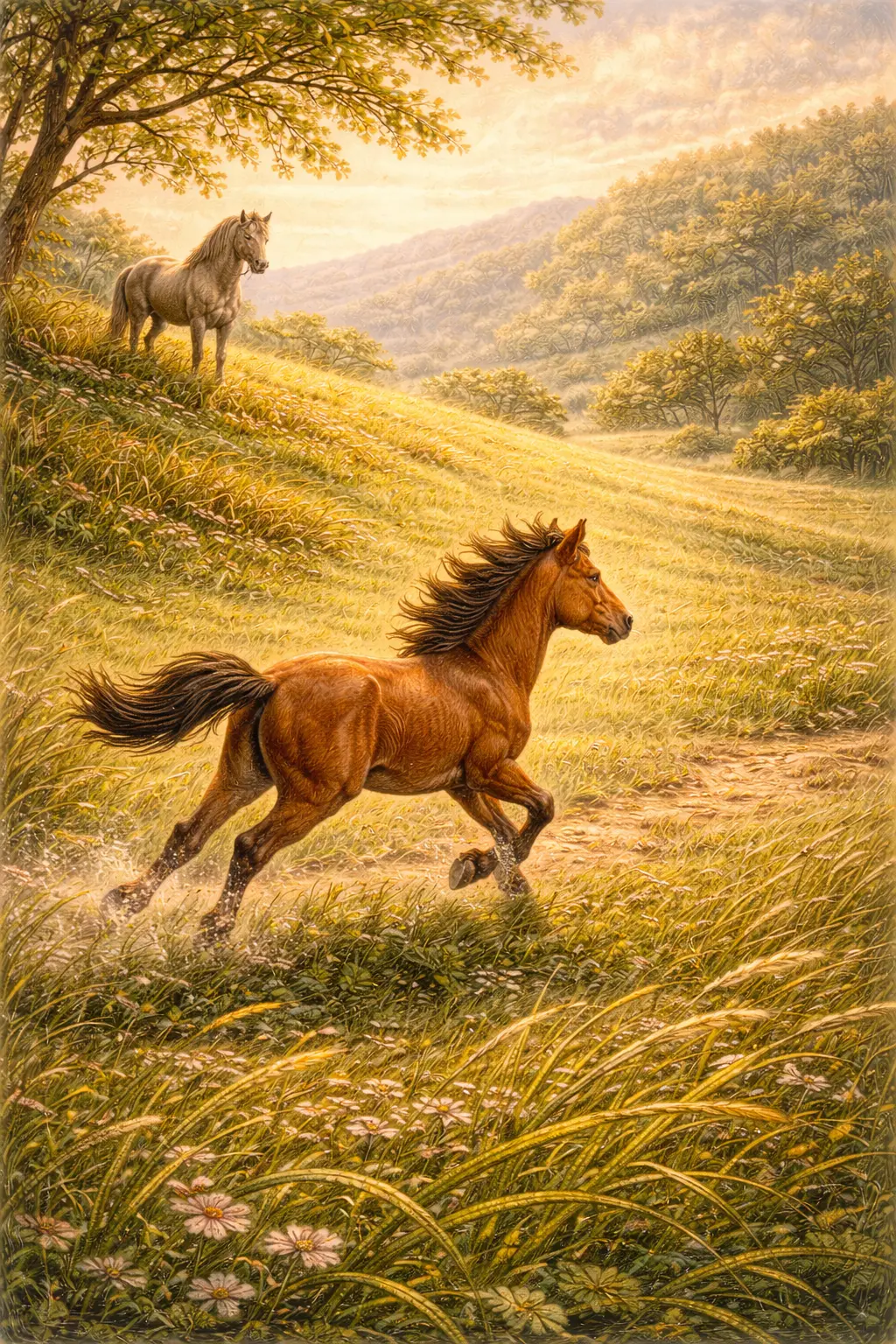
In a wide green valley lived a young horse named Arin.
Arin was strong and full of energy. Sometimes, without warning, a powerful wind would rush across the valley. When it did, Arin felt his legs grow restless and his body surge with strength.
He would begin running wildly across the field, unsure what to do with the sudden energy inside him.
One day, after running in circles until he was exhausted, Arin walked over to an older horse named Soren who calmly grazed near the hill.
"Why does this happen to me?" Arin asked. "The wind comes, and suddenly my body wants to run. I cannot stop it."
Soren lifted his head and looked kindly at the young horse.
"The wind is not your enemy," he said. "It is simply part of the valley."
Arin tilted his head.
"But what should I do when it comes?" he asked.
Soren pointed toward the hills in the distance.
"When the wind rises," he said, "run toward something that matters."
So the next time the wind swept across the valley, Arin felt the same rush of energy in his body.
But instead of running in circles, he ran toward the hill.
Day after day he grew stronger, learning how to guide his strength instead of fearing it.
And soon the wind that once confused him became the very thing that helped him grow.